

The Cybersecurity and Infrastructure Security Agency (CISA) has issued an urgent warning regarding a critical flaw impacting global enterprise networks. Specifically, the agency added the CISA Check Point Security Gateway vulnerability to its Known Exploited Vulnerabilities (KEV) catalog. This decision follows alarming telemetry indicating that active threat actors are weaponizing the security flaw to orchestrate devastating ransomware campaigns. Consequently, federal civilian agencies and private sector enterprises must move rapidly to secure their perimeters.
Understanding the Flaw: CVE-2026-50751
Tracked as CVE-2026-50751, this security flaw represents an improper authentication vulnerability (CWE-287). It resides directly within the Internet Key Exchange version 1 (IKEv1) key exchange protocol implementation on Check Point Security Gateway appliances. However, even though IKEv1 is a legacy, deprecated protocol, many enterprise infrastructure environments still keep it enabled for backward compatibility.
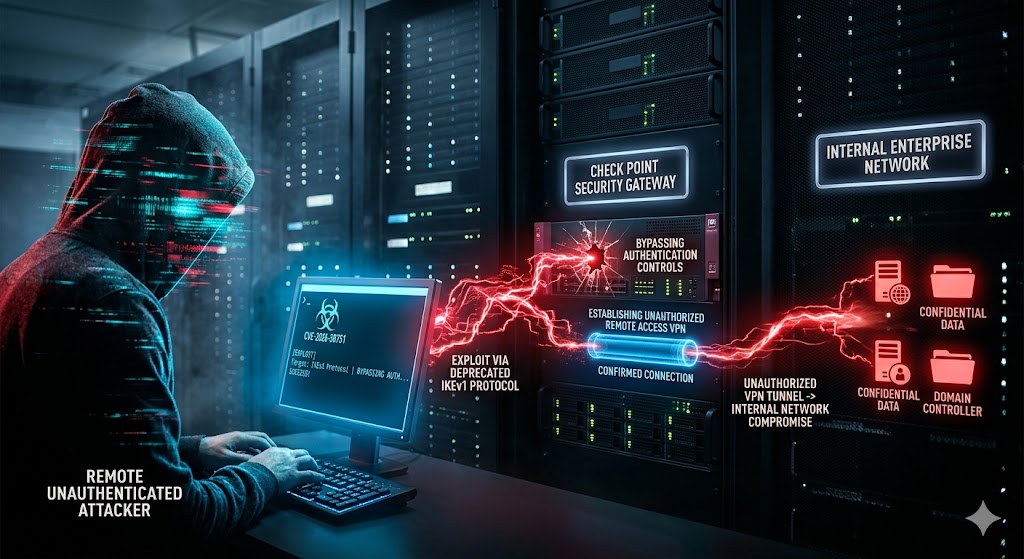
As a result, unauthenticated remote attackers can seamlessly bypass standard identity verification checks. By exploiting this weakness, a malicious actor can establish an unauthorized remote access VPN tunnel without ever providing a valid user password or token. Therefore, the traditional security boundary established by the gateway is effectively neutralized.
Why It Matters
This security flaw is exceptionally dangerous because it directly targets the perimeter access layer. In the past, attackers needed to harvest credentials through phishing or brute-force attacks to breach a corporate VPN. Conversely, this exploit allows them to walk right through the front door unnoticed. Because it completely ignores password requirements, typical network baseline defenses will fail to log a failed login attempt before the breach occurs.
Real-World Impact and Ransomware Risk
According to CISA, the real-world impact of the CISA Check Point Security Gateway vulnerability is already severe. Ransomware operators are actively leveraging this access vector to establish initial footholds inside corporate networks. Once a threat actor successfully establishes a persistent VPN tunnel, they can easily move laterally across high-value network segments.
Moreover, this unauthorized access allows them to compromise domain controllers, target sensitive data repositories, and exfiltrate proprietary information. Consequently, the final stage of these attacks typically involves the deployment of file-encrypting malware that can bring entire corporate operations to a sudden halt. In addition, bypassing multi-factor authentication (MFA) altogether means that standard defensive layers are rendered useless.
For more updates on edge device landscape risks, you can read our deep dive into /enterprise-security/ strategies.
Immediate Remediation and Mitigations
To assist network defenders, Check Point has rapidly deployed an official hotfix to mitigate this severe exposure. CISA mandated that all Federal Civilian Executive Branch (FCEB) agencies apply these fixes immediately to protect infrastructure. For private enterprises, the remediation steps should be treated with equal, top-tier priority.
First, administrators must apply the vendor-issued hotfixes detailed in the Check Point security advisory and support document SK185033. Second, organizations should explicitly disable the deprecated IKEv1 protocol wherever it is not strictly required. Transitioning entirely to IKEv2 is highly recommended, as it remains the modern, supported alternative. If applying the hotfix is impossible due to operational constraints, organizations should discontinue using the affected gateway instances immediately.
Furthermore, security teams must proactively audit their VPN connection logs. Look closely for anomalous session establishments that lack matching, valid credential authentication events.
To understand how this relates to broader network protection, check out our recent guide on /cybersecurity-news/ trends.
Enterprise Impact
For the modern enterprise, an unpatched security gateway represents an open invitation to ransomware groups. The financial consequences of a successful network intrusion include operational downtime, heavy regulatory fines, and long-term brand damage. Organizations utilizing legacy configurations must realize that keeping old protocols active for convenience directly introduces catastrophic structural risk.
⚠️ Warning for System Administrators: Check your gateway configurations immediately. If IKEv1 is active on any external-facing Check Point appliance, assume you are exposed and verify your authentication logs for signs of unauthorized VPN tunnel creation dating back to early June 2026.
🧾 KEY TAKEAWAYS SECTION
- The CISA Check Point Security Gateway vulnerability (CVE-2026-50751) is being actively exploited in active ransomware campaigns.
- The security flaw allows unauthenticated remote attackers to bypass MFA and password screens entirely.
- Attackers exploit the flaw via the legacy, deprecated IKEv1 protocol to build rogue remote access VPN tunnels.
- CISA added the flaw to its KEV catalog with strict remediation demands for federal networks.
- Organizations should immediately apply hotfix SK185033 and migrate their legacy VPN setups to IKEv2.
🔗 SOURCE SECTION Original News Coverage: Cyber Security News
No responses yet