

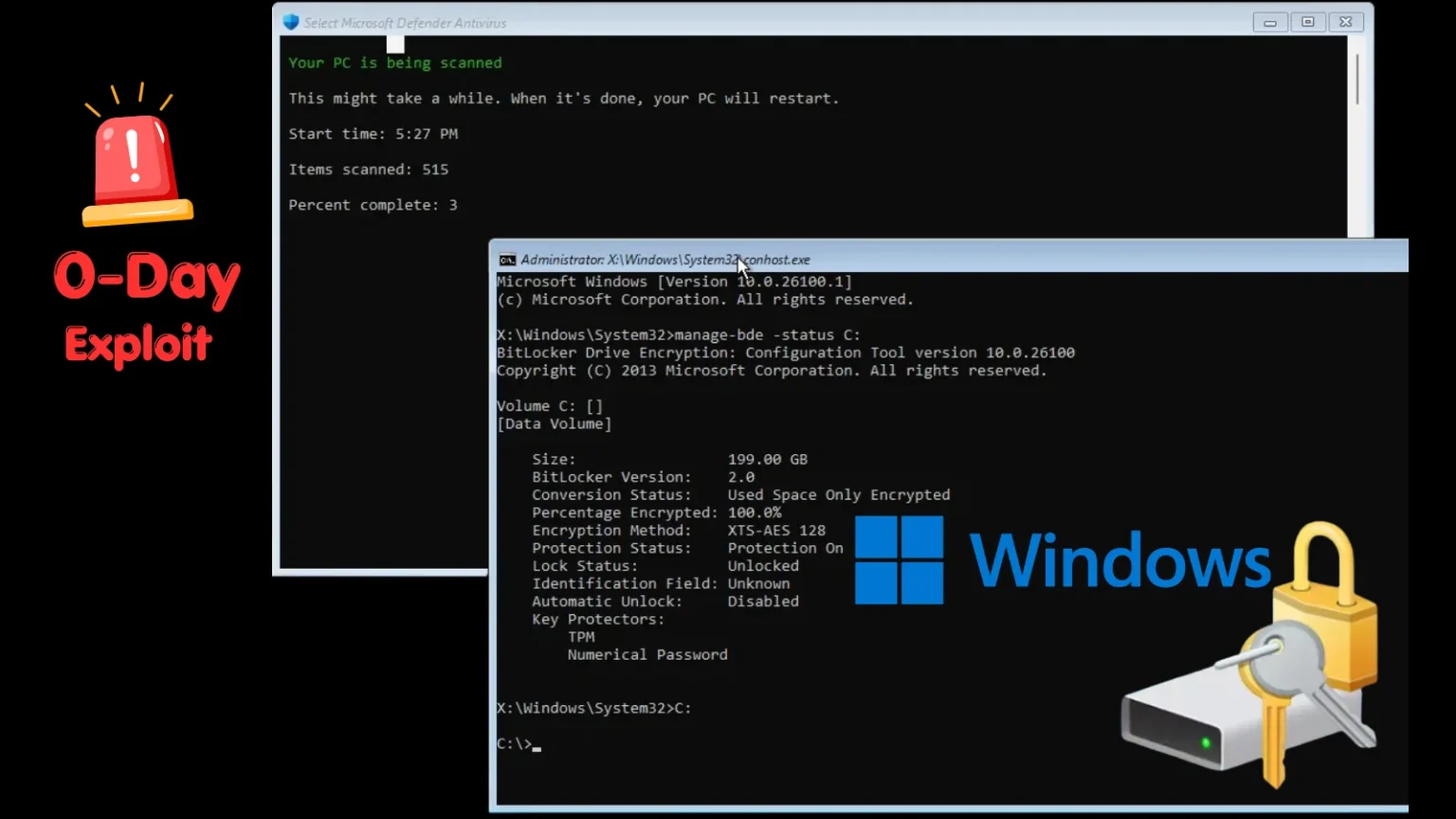
A newly disclosed zero-day exploit, known as GreatXML, can bypass BitLocker encryption on Windows systems. According to reports, attackers can exploit the flaw when they have physical access to a device.
In addition, the exploit is linked to behavior in the Windows Recovery Environment (WinRE) and Windows Defender Offline Scan. As a result, attackers may gain access to protected data without needing a BitLocker recovery key.
How the GreatXML BitLocker Bypass Works
According to researchers, the GreatXML BitLocker bypass 0-day uses artifacts left behind by Defender Offline Scan. Specifically, attackers may abuse recovery state conditions and WinRE behavior.
Furthermore, the attack involves placing crafted files in the recovery partition. These files can trigger unintended system behavior during boot. Consequently, the system may expose encrypted volumes protected by BitLocker.
The exploit has been publicly released as proof-of-concept code. Therefore, the risk of real-world abuse increases significantly.
Impact of the BitLocker Bypass 0-Day
The GreatXML BitLocker bypass 0-day affects the core security promise of BitLocker. For example, BitLocker is designed to protect data at rest if a device is lost or stolen.
However, this exploit may allow attackers to:
- Bypass BitLocker encryption protections
- Access sensitive files on locked devices
- Exploit recovery environment trust assumptions
- Gain SYSTEM-level access in some scenarios
In addition, security researchers warn that similar attacks often target recovery mechanisms rather than encryption itself.
A Growing Pattern of BitLocker Attacks
Moreover, GreatXML is not an isolated case. Recently, other BitLocker-related vulnerabilities such as YellowKey (CVE-2026-45585) have also been reported.
Consequently, attackers are increasingly focusing on Windows recovery and pre-boot environments. These components often trust system processes more than standard user-mode security controls.
How to Reduce Risk from GreatXML BitLocker Bypass
To reduce exposure to the GreatXML BitLocker bypass 0-day, organizations should take the following actions:
- Enable TPM + PIN instead of TPM-only BitLocker
- Restrict physical access to sensitive systems
- Monitor changes to the recovery partition
- Disable unnecessary recovery or boot options
- Apply Microsoft security updates when available
Furthermore, organizations should treat unexpected WinRE or offline scan activity as a potential security event.
Key Takeaways
- GreatXML is a BitLocker bypass 0-day exploit
- It targets Windows Recovery Environment and Defender Offline Scan behavior
- Attackers may access encrypted data without a recovery key
- The exploit is publicly available as a proof-of-concept
- Organizations should strengthen BitLocker configurations and physical security
Source: Cybersecurity News – GreatXML BitLocker Bypass 0-Day Exploited
https://cybersecuritynews.com/greatxml-bitlocker-bypass-0-day-exploited/
No responses yet